
In 2005, Alex Tew sold one million pixels on a webpage for $1 each. Brands bought tiny squares, linked them to their sites, and became part of a crowded mosaic of the early web. It was viral and human-facing: you looked at the grid, clicked a logo, and visited a website.
Twenty years later, discovery works differently. AI assistants, search agents, and Retrieval-Augmented Generation (RAG) pipelines do not browse the web like people. They ingest structured data, weigh signals, and synthesise answers.
Pixel Hive takes the spirit of the Million Dollar Homepage and rebuilds it for that world. Currently being developed as an active work in progress, it reimagines the concept not as a flat billboard, but as an experimental, machine-readable brand awareness registry mapped onto an interactive hexagonal grid.
The Big Idea
Pixel Hive is an experimental concept for an AI Brand Awareness Registry. Brands claim space on a virtual grid—conceptually one million units—and receive a structured, tiered presence that humans and AI systems can discover, index, and reason about.
Where the original site sold pixels as pure visibility, Pixel Hive explores the concept of Awareness Weight: a quantified signal of how prominently a brand is represented. More weight yields more grid territory, richer metadata, and stronger discoverability for AI agents pulling from the registry.
What You See: The Hive
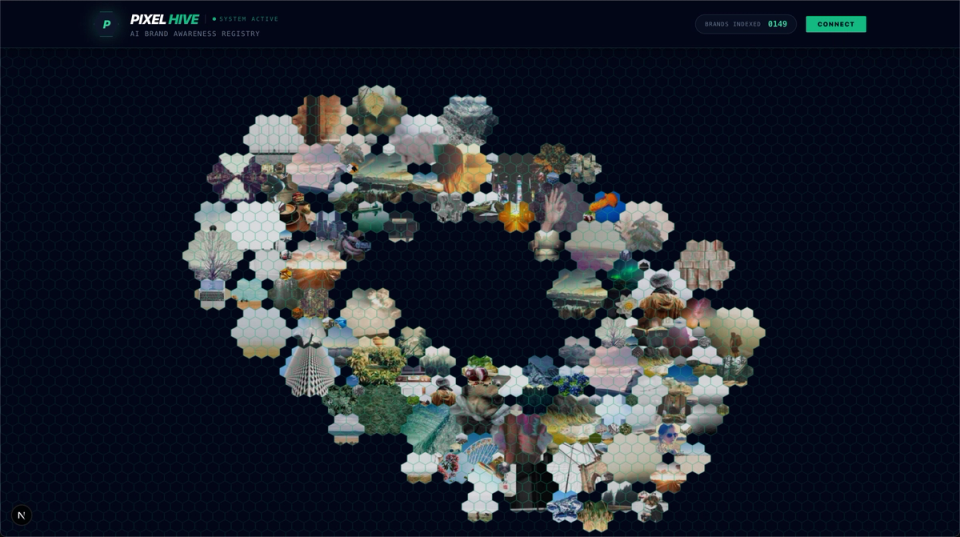
The project's interface features a full-screen canvas rendered in HTML5 using pointy-topped hexagons rather than squares, allowing brands to occupy clusters rather than isolated pixels.
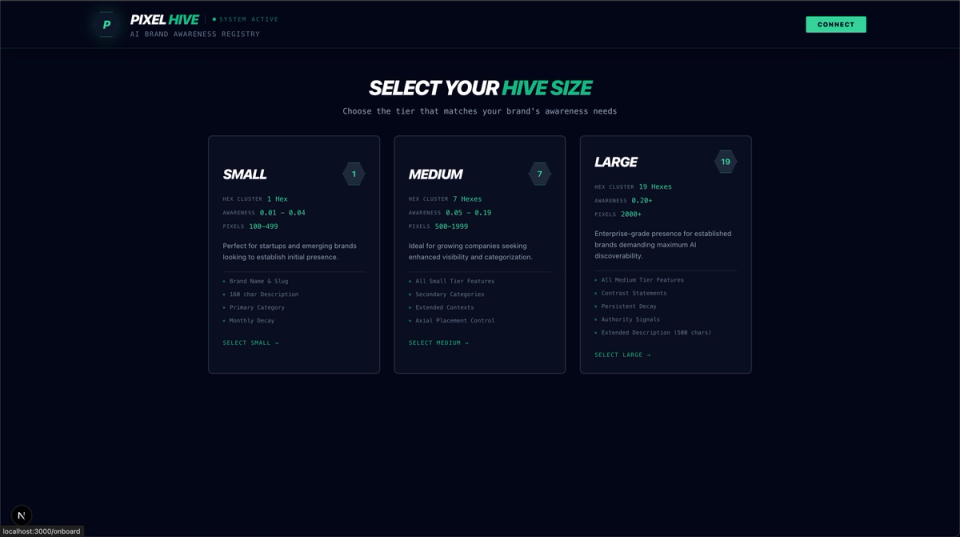
- Small Tier: 1 hex (centre only)—a single cell designed for emerging brands.
- Medium Tier: 7 hexes (centre + 1 ring)—a compact flower-shaped footprint.
- Large Tier: 19 hexes (centre + 2 rings)—a substantial territory on the map.
Hovering over a cluster triggers an emerald glow, a HUD-style tooltip, and a path to the brand's detail page. The visual style features a dark slate background, emerald accents, and monospace telemetry. Under the hood, the prototype grid uses axial hex coordinates and cube rounding for pixel-perfect hit detection. Categories cluster spatially—Enterprise AI brands neighbour other Enterprise AI entities, creating a semantic landscape.
Tiered Metadata for Humans and Machines
In the current prototype, every brand entry is validated against strict tier rules using Zod schemas. The vision for a full deployment would enforce these via PostgreSQL database constraints. A brand's tier determines both its Awareness Weight range and its structured context:
- Small Tier (Weight: 0.01–0.04): Brand name, slug, primary category, short description (160 characters), and a monthly decay model.
- Medium Tier (Weight: 0.05–0.19): Includes Small Tier specs plus secondary categories, extended AI context prompts, placement within category neighbourhoods, and optional persistent decay.
- Large Tier (Weight: 0.20+): Includes Medium Tier specs plus contrast statements (explicit declarations of what the brand is not to prevent AI hallucination), authority signals (ISO27001, SOC2, founding year), extended descriptions (up to 500 characters), and persistent decay.
Built for AI Discovery
Pixel Hive is being architected as an AI-first platform. In its current development build, this translates to several concrete technical choices:
- Server-Rendered Pages: Dedicated
/brand/[slug]pages built via Next.js deliver real HTML for crawlers to ingest. - JSON-LD Data: Embedded Schema.org Organization markup provides unambiguous structured identities.
- Registry API: A public
/api/registryendpoint returns the weighted brand list for RAG pipelines and agent frameworks to poll and rank without scraping. - Anti-Hallucination Guardrails: Large-tier contrast statements (e.g., "Provides AI analytics; does not sell consumer apps") establish clear boundaries for retrieval systems.
- Spatial Clustering: Hierarchical algorithms group semantically related brands adjacent to one another in hex space.
How Brands Join
The prototype onboarding flow (/onboard) guides users through tier selection and data validation. Once assigned spatial placement via the clustering algorithm, the brand is added to the system.
Because the project is an in-development proof of concept, submissions currently integrate with mock data for local testing. Future production builds target Supabase (PostgreSQL) with tier constraints baked directly into the database schema to ensure invalid combinations cannot slip through. Once processed, the interactive canvas updates, generates the permanent SSR detail page, and feeds the entity into the weighted registry API.
Potential Use Cases
As the concept evolves, Pixel Hive points toward several practical applications:
- AI-Native Directory: A citable registry for AI assistants evaluating real vendor metadata.
- Vertical RAG Corpus: A pre-clustered topical data source for domain-specific AI engines.
- Positioning Infrastructure: Explicit category boundary definitions via contrast statements.
- Authority Signal Registry: Schema.org-compatible validation for trust scoring.
- Market Mapping: An interactive landscape visualisation for human exploration and spatial machine reads.
- Structured Presence Model: A modern successor to early pay-for-presence web real estate, tailored for AI retrieval layers.
The Technical Foundation
The underlying technology stack for the current prototype includes:
- Framework: Next.js 15 (App Router) with SSR and API routes.
- Validation: TypeScript + Zod schemas for tier enforcement.
- Canvas: HTML5 Canvas with ref-based pan/zoom to eliminate React rendering lag.
- Database: Mock data for local development, with architectural support planned for Supabase / PostgreSQL.
- Math: Axial hexagonal math for spatial indexing, cluster sizing, and collision prevention.
From Pixels to Presence
The Million Dollar Homepage captured a web where human attention was the primary metric. Pixel Hive explores an ecosystem where AI systems mediate discovery. Brands need systems to understand their identities accurately: what they do, their category, what they explicitly avoid doing, and their structural weight.
While still a work in progress, Pixel Hive offers an early look at what that infrastructure could become—a grid where brands claim territory, build awareness, and publish structured identity for the machine age.